Team Building Rollercoaster

Torpedo Tech, guided by the visionary leadership of Alex Mercer, stood out as a beacon of ambition and ingenuity. Initially captivated by maritime marvels, the company was poised to embark on a new venture that promised to test the limits of its sky-high aspirations while navigating the challenges of organizational change.
Chapter 1: Navigating the Depths
The journey commenced with a bold goal: the development of a nuclear-powered, transparent submarine designed to revolutionize the world of cruise ships.
Project manager Jordan Lee was tasked with assembling a team capable of bringing this audacious vision to life. Embarking on a mission filled with technical challenges and breakthroughs, the team pushed the boundaries of what was possible beneath the waves. However, as they approached the completion of this underwater leviathan, the tides of innovation and strategy began to shift.
Chapter 2: A Voyage of Valor
Inspired by history and a strategic pivot, Alex Mercer redirected the company’s focus toward creating a nuclear, ideally fusion-powered, authentic sailing ship crafted from wood to cater to the desires of high-paying cruise customers.
This change in direction necessitated the team to adapt their expertise from the ocean depths to the vastness of the open seas.
The transition was monumental, requiring not only a change in technical focus but also a significant expansion of the team to include experts in maritime history, naval architecture, and ancient shipbuilding techniques. The project symbolized a fusion of past and future, aiming to create a vessel that was as much a tribute to historical maritime expeditions as it was a beacon of modern innovation.
Chapter 3: Stormy Seas
As Torpedo Tech set its course toward unveiling the wooden wonder of the seas, another storm was brewing on the horizon. The market winds shifted, and with them, Alex’s vision.
A decision was made to drastically reduce the team size and pivot the company’s direction once again. This time, the future lay not in the waters below or the ships that sailed them, but in the skies above.
The new directive was unequivocal: to pioneer in the realm of aviation, leaving behind the dreams of nuclear-powered maritime conquests.
This phase was fraught with challenges, as Jordan navigated the painful process of downsizing the team, bidding farewell to colleagues who had become akin to family. The transition was marked by uncertainty, as the remaining team members wrestled with the shift from naval engineering to aeronautics, a field that, while rooted in similar principles of engineering and physics, demanded new skills, knowledge, and perspectives.
Chapter 4: Soaring Ambitions
With a streamlined team and a fresh direction, Torpedo Tech embarked on its most ambitious project yet:
the creation of a fusion-powered, innovative aircraft made from transparent wood that promised to redefine aerial travel.
Drawing from the lessons learned in their previous ventures, the team harnessed their diverse expertise to pioneer advancements in aviation technology. The focus had shifted from sailing the seven seas to developing sustainable, cutting-edge aircraft capable of transforming the face of commercial and exploratory aviation.
The transition underscored the team’s resilience and adaptability. Under Jordan’s leadership,
they embraced the new challenge, channeling their collective grief from the layoffs into a determination to succeed.
The pivot to aviation ignited a renewed sense of purpose and innovation, propelling Torepdo Tech into a new era.
Epilogue: Beyond the Horizon
At least, that’s what could have happened. In reality, Jordan Lee awoke from this dream shortly after the team had been downsized. He increasingly received hints that, in fact, Alex Mercer was frequently complaining behind his back about the engineering team’s performance. Alex seemed to believe that the engineers were not delivering fast enough to keep pace with his ever-changing vision for the company. He attributed the commercial failures of Torpedo Tech not to poor management decisions or a lack of clear, coherent strategy—rooted in a commitment to short-term shareholder interests—but to the engineers’ supposed shortcomings.
The journey of Torpedo Tech, from the ocean’s depths to the sky’s expanse, was marked by relentless innovation, adaptability, and the courage to navigate uncharted territories.
The company could have emerged not only as a pioneer in technology but also as a testament to the human spirit’s capacity to adapt and thrive amid change—if only Alex Mercer had reflected on the tumultuous journey and recognized that the true value of Torpedo Tech lay in its people: their resilience, their ingenuity, and their unwavering commitment to pushing the boundaries of the possible.
Had Torpedo Tech soared into the future with this deeper understanding, it might have realized that the greatest achievements lie not in the destination, but in the journey and the lessons learned along the way.
The Flex Desk Police/y

Recently, on a sun-drenched tropical island, I found myself sipping a cool drink under the shade of a palm tree, a world away from the hustle and bustle of city life. It was here, amidst the serene beauty of this secluded paradise, that I stumbled upon a story so improbable, it could only be true. The protagonist of this tale was none other than Michael, a man whose name I had heard whispered in the corridors of legal circles and coffee shops alike, often shrouded in a mix of myth and legend.
Michael, now living under the guise of Peter, a simple islander, had invited me to his modest but picturesque beachside home after a chance encounter at the local market. As the sun dipped below the horizon, painting the sky in hues of orange and pink, Peter began to recount the tale of his escape from prison—a feat that had baffled and amused many over the years.
Let me recount his tale which he introduced as I well remember as :
“The Flex Desk Police”, bending the e towards a why with a twinkle in his eye:
In the not-too-distant past, the concept of flexible working had transcended the bounds of traditional office environments and found its way into the most unexpected of places: the penal system. The Flex desk Policy, originally designed to boost morale and productivity among prison staff, allowed employees to choose their working location within the facility, provided the spot was unoccupied at the time. Little did the administration know this policy would soon pave the way for one of the most audacious escapes in the history of the penitentiary.
Enter (or more precisely Exit) Michael, a prisoner with a penchant for the law and a keen observer of routines and regulations. Over the months, Michael had studied the Flex Desk Policy’s guidelines and noticed a loophole so glaring yet so overlooked that it bordered on the absurd.
He realized that the policy, in its generous ambiguity,
did not explicitly exclude prisoners from participating.
The plan was simple yet daring. Michael waited for the day when a significant number of staff would be attending an off-site training session, leaving several desks, including those in the security office, unattended. Early in the morning, under the guise of seeking legal materials for his upcoming appeal, he made his way towards the security office.
As he approached, he was stopped by a puzzled officer, who couldn’t fathom why a prisoner would wander near such a restricted area. With the confidence of a seasoned lawyer, Michael argued that the Flex Desk Policy did not specify “who” could claim an unoccupied desk, only that it could be claimed if it were unoccupied. The bewilderment and hesitancy in the officer’s eyes were all the confirmation Michael needed to know his audacious interpretation
had caught the guard literally off guard.
Leveraging the moment of confusion, Michael nonchalantly walked into the security office, sat down at the main desk, and began to feign work.
The few staff present, already accustomed to seeing unfamiliar faces due to the Flex Desk Policy, paid him no mind.
With access to the security system right at his fingertips, Michael discreetly unlocked the main gates and erased the day’s surveillance footage.
By the time the anomaly was discovered, Michael was long gone, leaving behind a facility in uproar and a policy in dire need of revision. The escape made headlines, sparking debates on the flexibility of work environments and the importance of clear policy language. Meanwhile, Michael, now a legend in his own right, had vanished into the ether, using the flex desk policy of the local airline.
In the end, elephants will fly.
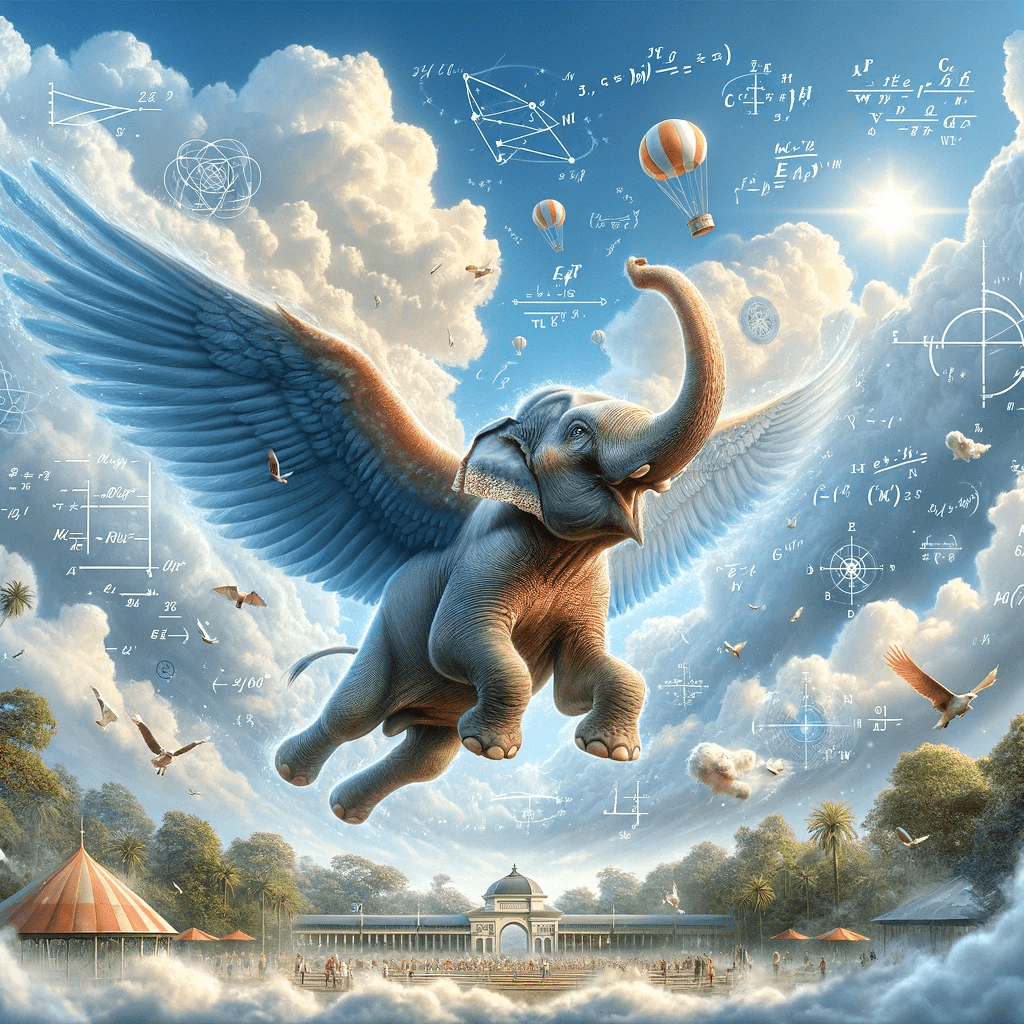
Dear, recently I applied to be an animal caretaker for elephants at the local zoo. While I feel comfortable as an animal caretaker, what specifically drove me towards this job was that they were also looking for somebody with ample experience in aeronautics and physics. Well, that job seems to be for me, or so I thought. The application process went well, and they were impressed with my resume. I’ll start tomorrow.
The new job has started quite well. I also met the zoo director, and he seems to be a decent person. What was a bit weird was that he told me that the main reason for hiring a new elephant caretaker was the previous one’s inability to teach the elephants how to fly, and that he was really looking forward to seeing me progress on this topic. What a weird joke.
As I write this, his words still echo in my auditory cortex. Let me put his words down for you:
“Imagine, a world where our elephants don’t just walk, they soar! This would not just be any project; it would be a revolution in zoology!”
I’m a bit puzzled. The peculiar joke is turning into a running gag, and Mr. Zoo director has asked me for regular progress updates on the flying elephant project (FEP) to which i kind of answered jokingly: “With all due respect, sir, elephants are not exactly… aerodynamically designed.” To which he answered, with what i took as a jest: : “That’s what they also said about airplanes, my dear!
It’s not about the design; it’s about the vision!”
Then the situation, let’s say, escalated. The director seemed really — non-proverbially — serious about this flying elephant thing, and I again insisted that elephants couldn’t fly. He was additionally making the point that he had seen flying elephants already, and that one of his colleagues had even told him that he had a “herd of elephants” in his zoo that had “flown from India directly to Germany”. I mentioned to him that, “…from a biological standpoint, elephants are definitely not flying animals and that, furthermore, physically and aerodynamically speaking, they can just not fly. Elephants are incapable of flight. That is a well-known fact and any zoologist, physicist, or aeronautical engineer in the world, will tell you the same”. He was not convinced and replied that “bumblebees are considered to be physically unflyable too, but they still managed to fly”. He left mumbling about “everyone knew it was impossible, until a fool who didn’t know came along and just did it”.
Today, Mr. Flying Elephant talked to me again about the FEP. He told me that he had consulted a physicist and that the physicist had shared with him that, from a quantum physical point of view, it’s very unlikely that elephants can fly, but not totally impossible, and that there’s an incredibly small probability that indeed an elephant could fly. I was trying to appease him and told him that that was true, but that his expectation of what “incredibly small probability” means was maybe a little bit off.
Today was another of “those” days. FEP man informed me that they had decided that they did not have the internal expertise to judge whether I was right or wrong, and thus had decided to sign a contract with an external consultancy to bring in more physical expertise. It seems like a bit of a waste of money to me, but what can I do?
Gods gracious, you would not believe what the Director just talked to me about…. “We’ve got investors interested! This is it! We’re going to be pioneers!” Me: “Please, this isn’t science anymore, it’s madness! We can’t keep doing this.” “You’re either with us on this, or you’re against progress. Don’t be on the wrong side of history.”
Today I had a talk with HR and the zoo director. They handed me an “Abmahnung”, some weird kind of German letter that tells me that I’m not performing as well as I should. It reads that the external consultancy had indeed agreed with my point that normally elephants can’t fly. But apparently they had also mentioned along the way that one could just change the gravitational constant of the universe and then elephants would fly, albeit with undesired further side effects. The “Abmahnung” goes on and reads that I “did not exhibit the right working approach” and that they were missing a kind of “can-do attitude”. It also reads that, in fact, they expect me to change the gravitational constant within the next month.
I handed in my resignation today.
The other day, I got an invitation from the zoo. The letter says that they have no bad feelings towards me, and thus they would like to invite me to the FEP day, which they will celebrate in two weeks. I’m really looking forward to FEP Day.
I was at the zoo on Sunday. I intentionally did not bring my family and went there as an honored guest alone. At the welcoming event, I met a very outspoken and friendly air logistics consultant who told me that he apparently got a “hot sales lead” from a colleague in another department of his company recently.
In the elephant enclosure, a “starting ramp” for the flying elephants had been prepared. Then a guy wearing a T-Shirt reading “quantum physics is bloody funny” was forcing the poor gray animals up the starting ramp, while an unhappy-looking caretaker with a group of penguins dressed up in suits was waiting nervously below.
I guess the resulting bloody puddle of elephant carcasses mixed with smashed penguins, the awestruck crying children holding helium-filled elephant balloons, and the resulting protests of animal rights activists can be considered “unintended further side effects”.
When I left, I spotted the nice logistic consultant in the parking lot. Somewhat surprisingly, he suggested going for a few drinks, to which I did not say no.
We found ourselves at a nearby hotel bar, the kind of place where the lighting is dim and the drinks are overpriced but strong. After some initial chit-chat about the weather and the latest sports scores, I found myself opening up more than I intended.
“I joined this field to make a difference, to connect people with nature… and here I am, and people expected me to instead connect wings to an elephant. I worked with people who mistake an obvious joke about the gravitational constants as serious. People who take stupid proverbial sayings as a generalizing sources of always applicable truth. Where did I go wrong? Or maybe it’s more general, when did all this start going wrong?”
He took a slow sip of his drink, eyes thoughtful, before replying dryly, “Well, if anyone can make elephants fly, it’s this zoo. Remember the underwater hamster exhibit?” “Yes,” I said, a bit of a laugh escaping despite myself. “I heard of it, wasn’t that a disaster too?” “Exactly my point,” he said, setting down his glass.
“Sometimes, the line between innovation and absurdity is just… a line in the sand, washed away by the next high tide of ambition or folly.”
I looked at him, surprised by his philosophical tone. He continued, “Look, as I just sold a quite profitable air cargo transport for a herd of elephants from India to Germany, I will need an expert in elephant care very soon. So let me soothe your pain with a generous offer…” He trailed off, an enigmatic smile on his face. As he whistled an old song about a burning circus, he handed me his business card and left. The card felt heavy in my hand, a tangible symbol of just how surreal my career had become. Oh my, I thought to myself, in the end, elephants will fly indeed…